Why Christian Families Need Faith-Based Children's Literature
I spent a lot of time behind the mic as a DJ from age 14 throughout my college years and beyond. In all that time and with all the music I played, it wasn’t until some years later when I began work as a News & Public Affairs Director at a community radio station in Nebraska that I came across the album ‘Calypso is Like So…’ by Robert Mitchum. Yes, that Robert Mitchum. Of films like El Dorado, Midway, The Winds of War and The Longest Day – talk about a cast, look that cast up sometime and be amazed. And he appeared in the original Cape Fear as well as the 1991 remake.
For the longest time, I thought Mitchum was actually from the Caribbean. Not so. Connecticut, actually. In 1956, Mitchum was totally burned out. He had done film after film after film and needed some serious downtime. So, off he went to Trinidad and Tobago.
The music he heard there inspired him and in 1957, Capitol Records - on the strength of Harry Belafonte’s successful Calypso album the previous year - gave Mitchum a shot at it. And I must say, I am glad they did, because I have enjoyed it since the day I discovered it. The album also includes ‘The Ballad of Thunder Road’ which is from the movie of the same name. A film based on a story by Mitchum and starring Mitchum. Busy, talented dude!
One of the songs on Mitchum’s album is titled ‘What is This Generation Coming To’ and he sings about how teenagers in the U.S.A. are driving their parents crazy by listening to Elvis Presley and Belafonte instead of what their parents consider appropriate music – Liberace, the opera, the symphony. You get the drift.
I would be willing to bet there is data out there somewhere that shows that every generation thinks the next generation coming up is in trouble for any number of reasons. How many times have you or someone you know said something like ‘I fear for our world when this next generation is running things’. I have heard that sentiment for years, both directed at my kids’ generation and also directed at my own.
Suffice to say, that comment has probably been around for a millennia. Or three.
Believing that your generation is elevated in some way above the younger folks probably stems naturally from simple knowledge and experience. In a word, maturity. Surely, we would not expect a group of 12-year-olds to have solutions to problems that primarily impact adults.
But it would also be unwise to pretend the younger end of the ‘iPhone Generation’ – which I define as anyone who was of reasonable usage-age when the first iPhone came out – has not had to deal with a concentrated level of negativity that prior generations simply did not. Instant access to information means instant access to both the good and the destructive.
My generation didn’t grow up with iPhones or social media. For all the positives you can lay at the feet of social media, you must also agree the negatives are Himalayan in contrast. Both the content itself and the ability to post incendiary and inaccurate information - both anonymously and instantaneously - means young minds with undeveloped prefrontal cortexes can be confused and overwhelmed by that hot garbage with which they are inundated every week. Every day. Every hour. Every minute. Every second.
We were not meant for that. It is sensory overload of the worst kind. And it is causing harm.
And if the downside of social media exposure isn’t enough, Christian parents (and even tens of thousands of non-Christian parents) have had the striking revelation of what they also feel is unhealthy content to which their kids have been exposed in public school curriculum and they also have additional and quite reasonable concerns about school safety.
We can certainly argue about what is and what is not appropriate to expose to kids. What we cannot argue about is the age at which children are exposed to certain material. That responsibility lies solely with parents and guardians – not with the State.
This issue came to a head in the aftermath of the COVID pandemic. Once parents all across America – in both so-called ‘red’ states AND ‘blue’ states – got an up-close look at what their kids were being taught, they were upset and often disgusted. They had put their trust in teachers and school systems and were seeing things with which they vehemently disagreed.
Thus, the homeschooling boom began.
It’s not that homeschooling wasn’t already in existence and popular. But prior to the pandemic, homeschooling was only growing at about 2% annually. Since then, homeschooling has grown at 5% annually – and it is trending upwards.
And according to the Johns Hopkins School of Education, homeschooling isn’t just growing in ‘red’ states the way it is often portrayed in the media. In fact, the four highest growth rates for homeschooling have been in South Carolina, Ohio, New Hampshire and Vermont. No one who follows American politics is going to claim that New Hampshire and Vermont are ‘red’ states.
It may surprise you to know that homeschooling knows no real demographic boundaries, with equal growth across all socio-economic and racial/ethnic categories.
And while the media has also tried to label homeschooling as belonging to ‘religious extremists’, the data shows a very different story. A 2023 Washington Post-Schar School poll showed that while about 2/3 of homeschoolers identify as ‘religious’, only about 16% chose homeschooling for primarily religious reasons.
Many parents do not feel homeschooling is an option for them. Whether that is true or not probably depends on many personal factors. My parents spent a considerable amount of time reading to me and having me read to them. I was significantly ahead of my classmates even by kindergarten. But that’s intellectual stuff; vocabulary, spelling, comprehension.
I can’t say whether or not I was better ‘morally’ prepared than most of my peers when I started school. I think I probably was, though. I went to Sunday school and had a very thick children’s Bible which I really loved. My parents spoke to me regularly about right and wrong so I certainly had built an initial moral compass by then, though it would of course be honed over the coming years.
Did I get a Christian education at home? Yes. No doubt. Did I have Bible-based kids’ books? Yes, I know I did. I did not have what you might call Christian homeschool books. But it would be hard to argue that I wasn’t given a version of Christian worldview parenting. Of course I was. It wasn’t formal, but it was woven throughout our daily lives.
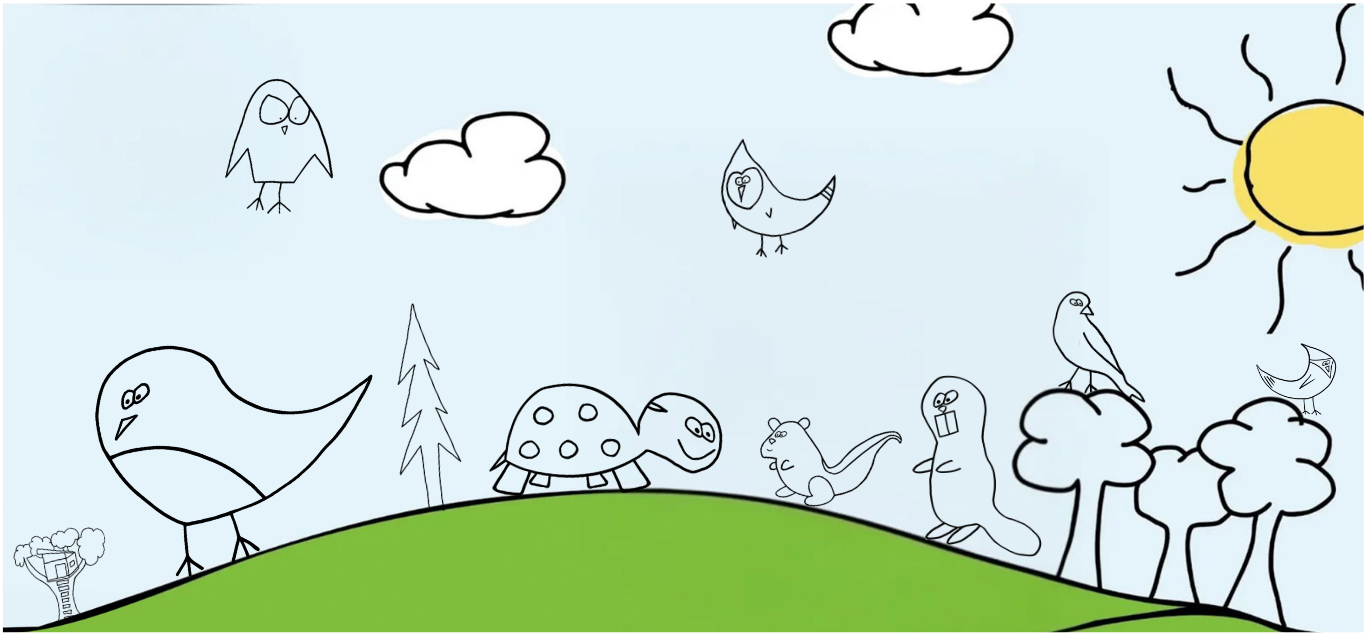
Faith-based children’s literature provides information that is critical for kids. Whether you choose to homeschool or not, providing young children access to Jesus’ teachings and the Ten Commandments is enriching and helps establish that moral compass. Important messages can get across in slightly more subtle ways and I think Faith Critters is effective at that.
Politicians – and I would say, for unfortunate but often obvious reasons – have recently been critical of displaying the Ten Commandments in various government environments, even though this was the standard in prior decades. The main reason provided in these objections is a massive misunderstanding of the phrase ‘separation of church and state’, which appeared in a letter written by Thomas Jefferson in 1802, and appears nowhere in the U.S. Constitution itself. In fact, until June 1963, biblical teachings were a part of public education. Can we really say we’ve been better off since the Abington School District vs Schempp decision?
What could possibly be the argument against teaching children that stealing, adultery, honoring parents or murder is wrong? And in Matthew 22: 37-40 Jesus summarizes and distills the Ten Commandments even further: Love God and love your neighbor as yourself. A perfect focus on the heart. Love. Simple, really. And isn’t that universal?
Exposing children to books that can relay Biblical teachings at their level and in a way that can be easily absorbed provides a critical framework for the way they will see and interact with the world. Such books and the characters within provide guideposts along the path of life.
These stories reinforce what you may already be teaching them anyway and that’s fantastic! Sometimes, kids just receive messages differently when they come from Bob the Tomato or a little lost robin instead of Mom or Dad.
JF
Faith Critters is a series of faith-based children's books built around exactly this idea, that the right story, at the right age, can plant something lasting. The Robin and the Rainbow and the second book in the series, The Turtle and the Treehouse, honoring my mother, Judy, are both available now, you can find them here. To follow the journey as new stories come to life, Join the Flock here.